
Over the last seven days, space activity has spanned rocket launches, solar weather monitoring, crewed operations in orbit, and fresh skywatching guidance for 2026. SpaceX opened 2026 with an Italian Earth‑observation satellite launch that extended the life of a key radar imaging constellation. NOAA confirmed that its SWFO‑L1 spacecraft for real‑time solar storm monitoring is performing as expected ahead of orbital insertion later in January. NASA previewed two January spacewalks to upgrade the International Space Station’s power systems and external hardware. For observers on the ground, NASA highlighted bright Jupiter, a Moon–Saturn pairing, and the Beehive Cluster as major January skywatching targets. Together, these developments underline how launch providers, science agencies, and astronauts are shaping Earth observation, space weather prediction, and public engagement with the night sky.
SPACEX OPENS 2026 WITH COSMO-SKYMED EARTH OBSERVATION LAUNCH
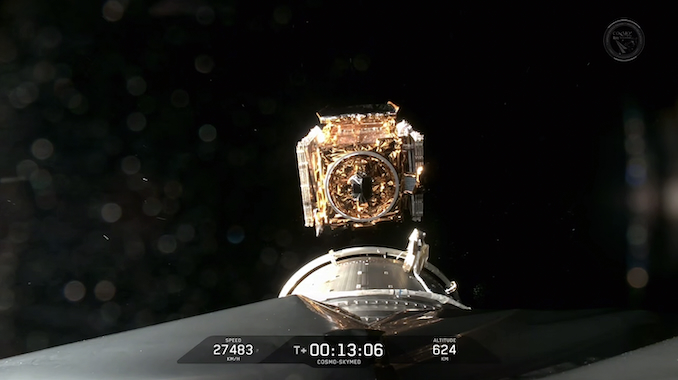
On January 1, 2026, SpaceX began the new year by launching an Italian Cosmo‑SkyMed Earth observation satellite on a Falcon 9 rocket from Vandenberg Space Force Base. Liftoff occurred from Space Launch Complex 4 East at 6:09 p.m. PST (9:09 p.m. EST / 0209 UTC), with the rocket flying a southern trajectory into a Sun‑synchronous orbit. The mission followed scrubbed attempts on December 27 and 28 due to hydraulic and pad‑related issues, making it the first Falcon rocket flight in 16 days—SpaceX’s longest orbital gap in four years. Falcon 9 booster B1081, flying its 21st mission after supporting NASA flights such as Crew‑7 and PACE, carried the roughly 2,230‑kilogram satellite. The Cosmo‑SkyMed spacecraft is designed for a five‑year lifespan in a 620‑kilometer‑high circular orbit, funded by the Italian Space Agency and the Ministry of Defense. Its X‑band synthetic aperture radar enables high‑resolution imaging through clouds and darkness, supporting both civilian and defense applications. The successful deployment strengthens Italy’s radar constellation for environmental monitoring, disaster response, and security surveillance. The flight also demonstrated continued high‑cadence reuse of Falcon 9 hardware as SpaceX transitions into its 2026 launch campaign. Spaceflight Now
NOAA’S SWFO-L1 SOLAR STORM MONITOR NEARS KEY ORBIT MILESTONE
On January 5, 2026, NOAA reported that its Space Weather Follow On–Lagrange 1 (SWFO‑L1) spacecraft remains on track for orbital insertion around January 20, 2026. Engineers continue to evaluate instrumentation and data, and all systems are performing as expected during the cruise phase toward the L1 Lagrange point between Earth and the Sun. The mission’s compact coronagraph (CCOR‑2) instrument is scheduled for its first door opening on January 21, enabling early performance checks and imagery of the solar corona. By operating at L1, SWFO‑L1 will provide continuous, upstream monitoring of solar wind and coronal mass ejections that can trigger geomagnetic storms at Earth. These real‑time observations are critical for forecasting space weather that affects power grids, communications, GPS, and satellites. NOAA’s update indicates strong confidence among system engineers that the spacecraft will meet its operational readiness timeline. Once fully commissioned, SWFO‑L1 will augment and eventually replace aging solar‑monitoring assets, improving warning times for severe solar events. The January status report marks a major step toward more resilient space‑weather forecasting capabilities in 2026. Space Weather
NASA PREVIEWS JANUARY 2026 ISS SPACEWALKS FOR POWER UPGRADES
On January 5, 2026, NASA held a briefing previewing two upcoming spacewalks to upgrade the International Space Station in early January. On Thursday, January 8, NASA astronauts Mike Fincke and Zena Cardman are scheduled to conduct a spacewalk to prepare for the installation of new International Space Station Roll‑Out Solar Arrays (IROSAs). These roll‑out arrays will boost the station’s power generation, supporting future science experiments and visiting vehicles. A second spacewalk on Thursday, January 15, will see two NASA astronauts replace a high‑definition external camera and complete additional hardware changes outside the orbiting laboratory. The planned work continues a multi‑year campaign of power system upgrades that has already seen several IROSA units added to the station’s truss. NASA officials emphasized that these activities help extend ISS operational life into the later 2020s while maintaining robust research capability. The briefing also offered mission timelines and safety considerations for viewers and media following the extravehicular activities. Together, the January spacewalks highlight ongoing human presence and maintenance essential to sustaining the ISS as a unique microgravity laboratory. YouTube
JANUARY 2026 SKYWATCHING: JUPITER, SATURN AND THE BEEHIVE CLUSTER
On January 4, 2026, NASA released its “What’s Up: January 2026” skywatching guide, outlining major observing opportunities for backyard astronomers. Jupiter reaches its biggest and brightest point of the year around January 10, making it an excellent target for binoculars and small telescopes. The guide also highlights a conjunction of the Moon and Saturn on January 23, when the two objects will appear close together in the evening sky. Throughout January, observers can look for the Beehive Cluster (Messier 44) buzzing into view in the constellation Cancer as a rich open cluster of stars. NASA’s monthly guide explains how to locate these objects using simple star‑hopping techniques and emphasizes that dark skies improve visibility. The update encourages both beginners and experienced observers to track planetary motion and seasonal constellations over several nights. These recommendations help connect the public with ongoing planetary missions and broader solar‑system science. The January 2026 edition continues NASA’s effort to make skywatching accessible and engaging worldwide. NASA